
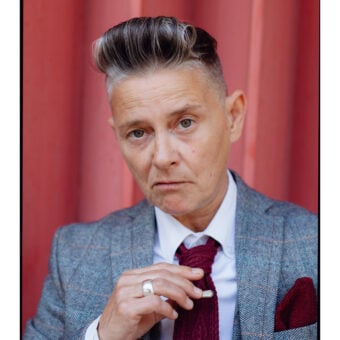
Joelle Taylor

Joelle Taylor FRSL is the author of four poetry collections and one novel. C+NTO & Othered Poems won the T.S Eliot Prize, and the Polari Book Prize, and is currently being adapted both for theatre and film. Her novel The Night Alphabet was named both a Spectator and Guardian Book of the Year. She is a 2026 Cholmondeley Award recipient, and a former Saboteur Spoken Word Artist of the Year. She was recently honoured with a DIVA Award for Outstanding Contribution to Literature and named in the 2026 Pride Power list. Her new collection Maryville is published by Bloomsbury and has been shortlisted for the Sky Arts Award and longlisted for the Polari Prize.
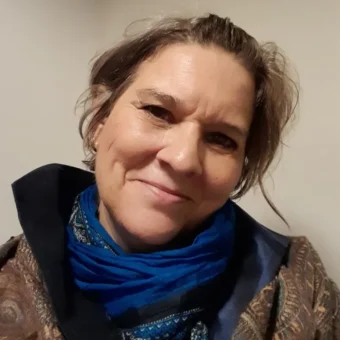
Michelle Elvy
Michelle Elvy is a writer and editor in Ōtepoti Dunedin, Aotearoa New Zealand. Her books include the everrumble, the other side of better and the poetry collection Motion Sickness. Founder of NFFD NZ, Flash Frontier: An Adventure in Short Fiction and At the Bay | I te Kokoru, Michelle also worked on the editing team of Best Small Fictions 2015-25 and has co-edited numerous anthologies, including A Kind of Shelter: Whakaruru-taha (with Witi Ihimaera, 2023), the dual-language Poto! Iti te kupu, nui te kōrero | Short! The big book of small stories (with Kiri Piahana-Wong, 2025) and the forthcoming call to the world, MAYDAY (with David Eggleton and Siobhan Harvey). michelleelvy.com
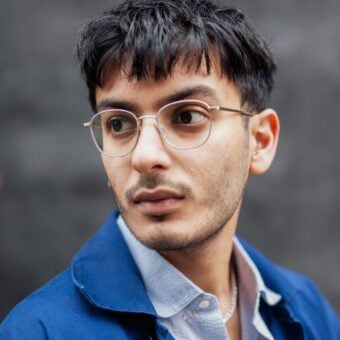
Gurnaik Johal
Gurnaik Johal is a writer from west London. His 2022 collection We Move won a Somerset Maugham Award, the Tata Literature Live! Prize and the Galley Beggar Short Story Prize. In 2025, he was named an Observer Best New Novelist, and Saraswati, his debut novel, was nominated for the Waterstones Debut Fiction Prize, the Sunday Times Charlotte Aitken Young Writer Award, the Jhalak Prize and the RSL Ondaatje Prize, and also won a Somerset Maugham Award.
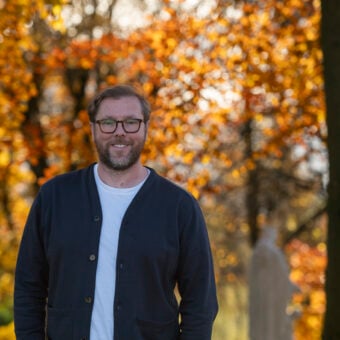
Damian Barr
Dr Damian Barr is an award-winning writer. His latest novel, The Two Roberts, reimagines the lives of artists Robert MacBryde and Robert Colquhoun. It’s a Guardian and BBC Best Book of 2025. He curated a landmark touring exhibition of their work for Charleston. Barr’s memoir Maggie & Me won Sunday Times Memoir of the Year and he adapted it as a major play with the National Theatre of Scotland. His debut novel, You Will Be Safe Here, was a Radio 4 Book at Bedtime. He is a Fellow of the Royal Society of Literature and champion for libraries.
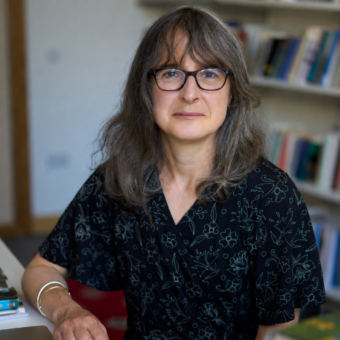
Sarah Moss
Sarah Moss writes novels, memoir, essays and literary journalism.
Her books include Ghost Wall, Summerwater, and most recently Ripeness and My Good Bright Wolf, which won Saltire Scottish Non-Fiction Book of the Year 2025.
She has been nominated for prizes including the Women’s Prize, the Wellcome Prize, the Polari Prize and the RSL Ondaatje Prize, and was made Fellow of the Royal Society of Literature in 2019.
Sarah has a BA, M.St. and D.Phil from Oxford University and has taught and directed Creative Writing MA and MFA programmes at several universities.
She was born in Scotland, grew up in northern England and now lives in Dublin.
What draws you to memoir as a form and how do you decide when an experience demands it rather than fiction? What do you think memoir can do that fiction can’t?
I find myself drawn to memoir by experiences too outlandish or resistant to narrative for the forms of fiction. We all have experiences stranger than fiction, and the novel demands structures and developments and kinds of meaning that we don’t find in real life. Memoir can fall into forms like fiction’s, but it can also negotiate and create its own ways of story-telling.
What are you looking for in a memoir’s opening pages? Is there something a voice can do, or fail to do, that says immediately if you’ll be gripped?
One of my mentors earlier in my teaching career used to say that the point of teaching creative writing is to get the students to write the story only they can tell. I don’t think that’s always true, but it’s a good place to start, especially with memoir. I’m looking for fidelity to the complications and contradictions of real life and recollection.
Is there a piece of advice on writing memoir you find yourself giving again and again?
Not just memoir: don’t be afraid of complexity. Reality is difficult, and the best response to difficulty is curiosity.
Can you share three memoirs which have stayed with you? What is it about them you keep returning to?
Janet Frame’s autobiography; Kathleen Jamie’s essay collections; Jonathan Raban’s Passage to Juneau. In very different ways, they all make a principle of bringing intelligence to ’small’ observations that open up into very big questions; they all command a beautiful sentence; they’re all committed to seeing and hearing and touching what’s really there and not what most people think is probably there.
Deadline for memoir entries: 30 September 2026, Midnight UK time.